
Compliance
IEC 62443: remote access as a controlled conduit
The IEC 62443 series divides an industrial system into zones joined by conduits, and asks that every crossing be identified, authorised and traced. Remote access is the most exposed conduit: it crosses a network you do not control. PipeLinker Hub makes it a single passage, target by target, with its rights, its log and its recorded sessions.
The path, in this order. The equipment - PLC, HMI, controller - is reached by the agent placed on a machine of its own network. The agent opens an outbound flow to the hub you host: nothing listens on the site, and no inbound firewall rule is requested. The hub carries the telemetry, the rights, the log and the recordable sessions. The authorised person enters through the hub, and reaches only the targets opened to them - never the site's network.
What the series requires, and from whom
IEC 62443, published by the International Electrotechnical Commission and adopted by ISA as ISA/IEC 62443, is the series of cybersecurity standards for industrial automation and control systems. It splits its requirements between three roles:
- the asset owner, who runs a security programme: Part 2-1;
- the integrator and the maintenance service provider, whose practices Part 2-4 frames - remote access included;
- the product supplier, who develops under Part 4-1 and whose components meet Part 4-2.
In between, Part 3-2 divides the system into zones and conduits from a risk assessment, and Part 3-3 sets a system's security requirements and its security levels, from SL 1 to SL 4, according to the attacker you mean to hold off.
The foundational requirements that bear on remote access
Part 3-3 groups its requirements under seven foundational requirements. Four decide what a remote access is worth:
FR 1 - Identification and authentication control
Every person is identified individually, and access over untrusted networks has its own requirement (SR 1.13), with, at higher levels, explicit approval of each access request. Multi-factor authentication over untrusted networks is required as the target level rises.
FR 2 - Use control
An identified person only does what their role allows, and a remote session ends, on request or after inactivity (SR 2.6). Security events are written to an auditable, timestamped log.
FR 5 - Restricted data flow
Zones are separated, and a conduit lets through only what was allowed into it. A remote access that gives the site's whole network turns a conduit into an open door.
FR 6 - Timely response to events
The log is accessible to authorised people and tools, and the system is monitored continuously: that is what makes an investigation possible.
The other three - system integrity, data confidentiality, resource availability - concern the whole system more than its remote access.
What PipeLinker Hub brings
One conduit, and only one, for remote access
The agent placed in the zone calls the hub outbound, and it is the only path: nothing listens in the zone, no firewall rule is opened towards it. A PLC or an HMI that does not carry an agent is reached through the agent of a machine in its zone, by a declared service - its address, its port, its protocol - and nothing else in the zone is reachable. That is FR 5's restricted flow, set service by service. The case of PLCs and HMIs.
Named people, and strong authentication
Every person working has their own account, never one shared by the team. A second factor is required by role, and a role can require a FIDO2 security key; an employee's account follows your directory. Just-in-time access is requested with a reason, approved - twice for a critical target - and closes by itself: the explicit approval SR 1.13 asks for at higher levels.
Rights by role, by fleet and by target
View, open a session, send a command, deploy an update, administer: each right is granted separately. A fleet is a partition - a site, a customer, a plant - that does not see the others; an integrator sees their customer's fleet and nothing else. Revocation is individual and immediate, and it also closes sessions already open.
Sensitivity levels, to follow the zones
Each service, machine or fleet is rated standard, sensitive or critical, and the level says what it takes to open it: a security key, a device whose state is proven, PipeLinker Desktop or Mobile rather than the browser, recording, an approval, hours windows. They are not the standard's SL levels, but they let you require more where the zone warrants it.
The log, the recordings, and the SIEM
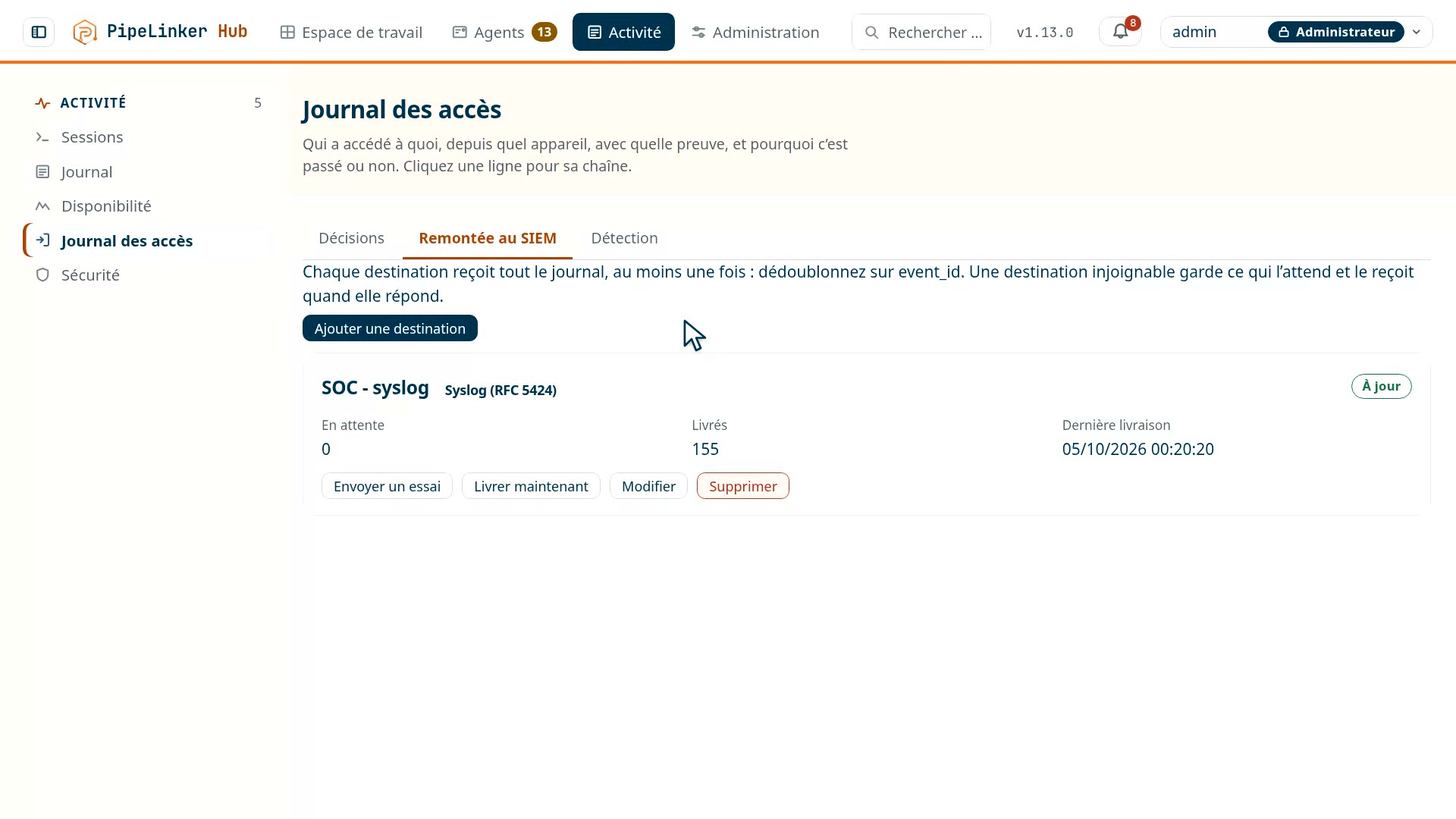
The log keeps who accessed what, when, on which machine and for how long, and the reason for each refusal. It exports and goes to your SIEM - syslog, Splunk, Microsoft Sentinel or OpenTelemetry. Terminal and screen sessions are recorded and replayed: what an integrator did is shown, not told.
 Prise 17
PLC credentials, sealed
When you configure it so, a target's credential stays sealed in the hub: the integrator receives the right to open the session, not the machine's password. They can neither keep it nor carry it to the next job.
Tell us your zones and who works in them. We show you the conduit, the rights and the log.
The mapping, requirement by requirement
| IEC 62443-3-3 | What PipeLinker Hub covers | What stays with you |
|---|---|---|
| FR 1 - Identification and authentication | yes, for remote access: named accounts, second factor and FIDO2 key by role, OIDC directory, one certificate per machine | the devices' own local accounts |
| SR 1.13 - Access via untrusted networks | yes: a single passage through the hub, outbound flow, approval of access requests | the other paths into the zone, to be closed |
| FR 2 - Use control | yes: rights by role, fleet and target, expiries, revocation that closes open sessions, timestamped log | use control inside the PLC or the HMI |
| FR 5 - Restricted data flow | partly: one declared service per target, nothing else in the zone reachable through the hub | network segmentation, firewalls between zones |
| FR 6 - Timely response to events | partly: exported log, forwarding to the SIEM, replayable sessions | monitoring and response |
| FR 3, 4, 7 - Integrity, confidentiality, availability | for its own flows: mutual TLS, signed agent updates | the rest of the system |
| 3-2 - Zones, conduits, risk assessment | no | your team, or outside support |
What PipeLinker Hub does not do
It is not IEC 62443 certified, and it does not make a system compliant. The standard is met by a programme, a risk assessment, a zoning and measures across the whole system; the hub holds the remote-access conduit, and helps demonstrate what goes through it. For the rest, LOOTUS SECURITY offers IEC 62443 compliance support (in French).
It does not read PLC registers in their industrial protocol: your supervision software does, and goes through the agent as a declared service.
The questions we get
Our customers ask us for IEC 62443-2-4. How does the hub help?
Part 2-4 covers the practices of integrators and maintenance service providers, remote access among them. The hub gives you what it takes to show yours: named accounts, rights bounded to the customer's fleet, approved access, a log and replayable sessions, and no port asked of the customer.
Does anything need installing on the PLC?
No. The agent sits on a machine in the zone and acts as a gateway; you declare the PLC's service, and it becomes reachable through it, with nothing else in the zone.
Where can the standard be read?
The parts of the series are sold by IEC and by ISA. ISA lists them, with the roles, on its overview page, cited below.
Sources
The series: ISA/IEC 62443 Series of Standards, ISA's page. System requirements: IEC 62443-3-3:2013, on the IEC webstore. This page presents technical information and is neither legal advice nor a certification of compliance.
Page last updated on 19 November 2026. Page maintained by the PipeLinker team at LOOTUS SECURITY, publisher of the product. The date comes from the repository, not from a hand edit.