
Compliance
NIS 2 and remote access: who enters, on what, and the proof
The NIS 2 directive requires essential and important entities to control access, to use multi-factor authentication and to report a significant incident within twenty-four hours. Remote access to systems - by teams, contractors, integrators - touches all three. PipeLinker Hub holds the technical part of it: rights, second factor, log and recorded sessions.
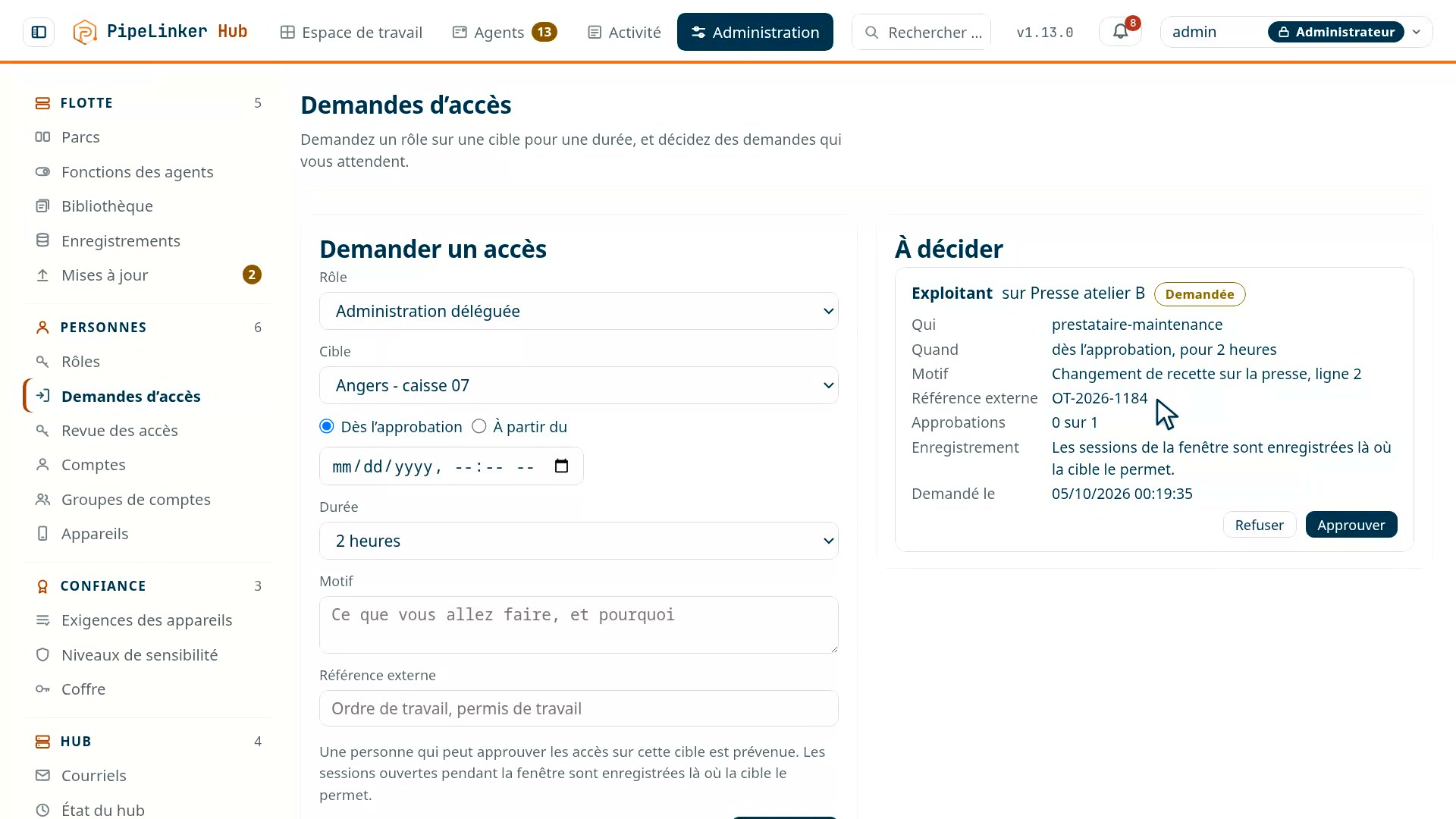 Prise 16
What the directive requires
The NIS 2 directive (Directive (EU) 2022/2555 of 14 December 2022) replaces the first NIS directive and widens its scope to many sectors - energy, transport, health, water, waste management, part of manufacturing, digital providers and managed service providers, among others. It distinguishes essential entities and important entities: the obligations are the same, supervision and penalties differ.
- 16 January 2023The directive enters into force.
- 17 October 2024Deadline for transposition by the Member States, who apply their texts from 18 October 2024.
- In each countryThe national law sets the scope and the authority: in France, ANSSI, whose MonEspaceNIS2 portal tells an entity whether it is concerned (in French).
- In FranceTransposition goes through the bill on the resilience of critical infrastructure and the strengthening of cybersecurity, known as the Resilience bill, which also transposes the CER Directive and carries provisions related to DORA. Adopted by the Senate at first reading on 12 March 2025, it was adopted by the Assemblée nationale on 17 November 2026, by 464 votes to 64. The process is not over: the two chambers must still agree on the same text before its final adoption (legislative file on the Assemblée nationale website, in French).
Risk-management measures (Article 21)
Article 21 requires "appropriate and proportionate" technical, operational and organisational measures, and sets a minimum list. Four of its points bear directly on access to systems:
- (b) incident handling;
- (d) supply chain security, including relationships with direct suppliers and service providers;
- (i) human resources security, access control policies and asset management;
- (j) the use of multi-factor authentication or continuous authentication solutions, and secured communications.
Reporting fast (Article 23)
A significant incident triggers an early warning within twenty-four hours of becoming aware of it, an incident notification within seventy-two hours with an initial assessment, then a final report no later than one month after. Saying within twenty-four hours whether a remote access is involved means knowing, fast, who entered where.
Management answers for it (Articles 20 and 34)
Management bodies approve the measures, oversee their implementation and can be held liable. Maximum fines reach at least EUR 10 million or 2% of worldwide turnover for an essential entity, and EUR 7 million or 1.4% for an important entity, whichever is higher.
Why remote access is a control point
Remote access is where points (b), (d), (i) and (j) meet. It is how contractors and integrators come in - the supply chain of point (d) -, it is what access control must bound, it is what must require a second factor, and its log is what you read again when an incident happens. A VPN shared between contractors, a remote-control tool installed on an operator station, or a firewall rule opened for a job make these four points hard to demonstrate. What a VPN gives, and what a job on site needs.
What PipeLinker Hub brings
Access control, target by target
Rights are granted to named people, by role, by fleet and by target: view, open a session, send a command, deploy an update, administer. Nobody receives a site's network: each person opens only the services they were allowed. A right can expire, and just-in-time access is requested with a reason and a work order reference, approved - twice for a critical target -, and closes by itself. Every quarter, a review has permanent rights reconfirmed by their owners, and its result exports.
Multi-factor authentication, required by role
A second factor can be required by role, and a role can require a FIDO2 security key, which answers only the real hub and resists the fake sign-in page that relays a code. An employee's account follows your directory (OIDC: Entra ID, Google, Keycloak), which cuts it on the hub as soon as it disables it. And each fleet can require a device posture, proven by the workstation's TPM or the phone's chip, checked again every five minutes: the continuous authentication point (j) names.
Sensitivity levels
Each service, machine or fleet is rated standard, sensitive or critical, and the level says what it takes to open it: a security key, a device whose state is proven, PipeLinker Desktop or Mobile rather than the browser, recording, an approval. Hours windows and origin rules add to it. It is the proportionality Article 21 asks for, set target by target.
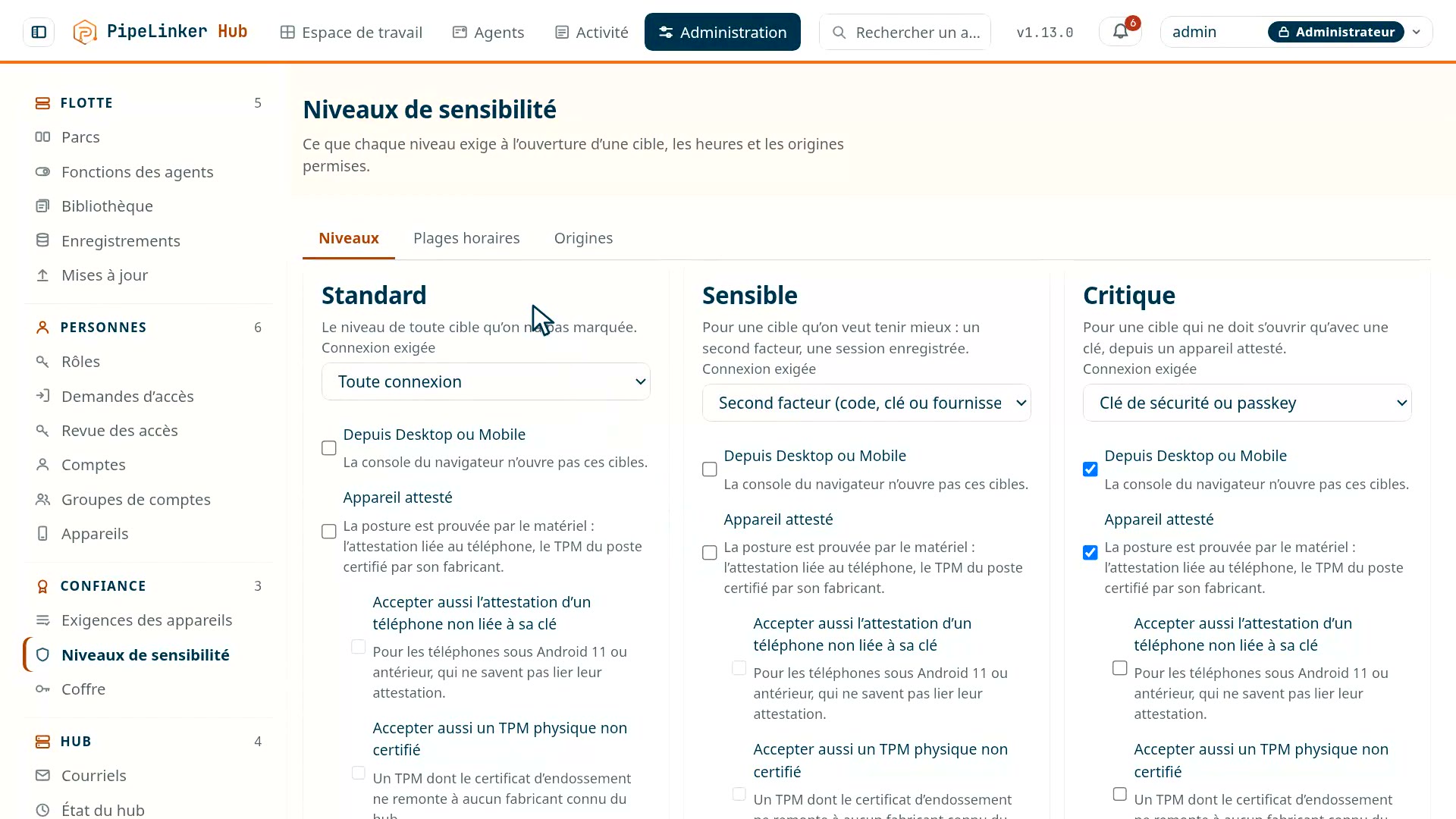 Prise 18
The access log, and the SIEM
The log keeps who accessed what, when, on which machine and for how long, with which proof and from which device, and the exact reason for each refusal. It goes to your SIEM - syslog, Splunk, Microsoft Sentinel or OpenTelemetry -, where the detection that incident handling requires takes place. Terminal and screen sessions are recorded and replayed with a time cursor: on the day of an incident, you show what happened instead of reconstructing it.
Contractors, without handing them the credentials
When you configure it so, the target's credential stays sealed in the hub: the contractor receives the right to open the session, not the machine's password. Their account can carry an end date, and revocation is immediate, open sessions included. That is the part of the supply chain that goes through remote access.
No inbound port, and the hub on your premises
The agent calls the hub outbound: nothing listens on the sites, no firewall rule is opened for a job and then forgotten. The hub is one binary and a PostgreSQL database on the machine of your choice: the log and the recordings stay with you, with your retention periods. Why there is no port to open.
Tell us who works on your systems, and from where. We show you the rights, the log and the replay.
The mapping, point by point
What Article 21 requires that touches remote access, what PipeLinker Hub covers of it, and what stays with you. A row without "yes" is not a hidden gap: it is what the product does not claim to do.
| NIS 2 | What PipeLinker Hub covers | What stays with you |
|---|---|---|
| (i) Access control | yes, for remote access: rights by role, fleet and target, expiries, just-in-time access, quarterly review of rights | the access control policy, and access that does not go through the hub |
| (j) Multi-factor authentication | yes: second factor and FIDO2 key required by role, OIDC directory, device posture checked again | the entity's other applications |
| (i) Asset management | partly: the inventory of machines carrying an agent, and of their packages | the rest of the fleet, and the asset register |
| (d) Supply chain | partly: named contractor accounts, sealed credentials, end dates, recorded sessions | contracts, supplier assessment |
| (b) Incident handling | partly: access log, refusal reasons, export to the SIEM, session replay, immediate revocation | detection, response, the incident procedure |
| (h) Cryptography | yes, for its own flows: mutual TLS, one certificate per machine, the key in the TPM when there is one | the entity's cryptography policy |
| Article 23, reporting | no: it says fast who entered where | the early warning and the notification, to the authority or the CSIRT |
| (a) Risk analysis, (f) effectiveness, (g) training | no | your team, or outside support |
What PipeLinker Hub does not do
It does not make an entity NIS 2 compliant. Compliance involves risk analysis, governance, continuity, training and the reporting procedure; the hub helps demonstrate the part that goes through remote access and through the machines it knows. For the rest, LOOTUS SECURITY supports compliance projects (in French).
It does not detect attacks in place of your SIEM. It spots deviations on accounts and access, and sends you the log; correlation with the rest of the information system happens on your side.
The questions we get
Are we in scope of NIS 2?
It depends on the entity's sector, size and activity, under the directive's annexes and the national transposition. The national authority answers that; we do not answer in its place.
Is a managed service provider in scope?
Managed service providers and managed security service providers are among the directive's sectors, and Implementing Regulation (EU) 2024/2690 details their measures: privileged accounts, administration systems, strong authentication, access logging. If you run your customers' fleets, that is your case.
Is the access log enough as proof?
It is part of it: it says who, what, when, on which machine and with which proof, and replayable sessions show how it went. It replaces neither the policy it enforces nor the documentation of your measures.
Sources
The directive: Directive (EU) 2022/2555 on EUR-Lex (Articles 20, 21, 23, 34 and 41). Detailed measures for managed service providers: Implementing Regulation (EU) 2024/2690. ANSSI: MonEspaceNIS2 (in French). Transposition in France: the bill's legislative file on the Assemblée nationale website (in French). This page presents technical information and is neither legal advice nor a certification of compliance.
Page last updated on 19 November 2026. Page maintained by the PipeLinker team at LOOTUS SECURITY, publisher of the product. The date comes from the repository, not from a hand edit.